Be part of a growing team of hybrid innovators and slide into today's groove with in-house, internship or outsource employment.
WELCOME TO ASA PUBLISHING CORPORATION
Book publishing is suppose to fun and enjoyable, including being able to enjoy the profession that you're in or want to be a part of. We are a global client and employment corporation. We have been established since 2005 and has become one of the world's leading publishing houses as a hybrid. This is only through teamwork; acting together as one in the ASA Publishing family. Even though we are a business, we believe in the power of prayer and the encouragement towards each fellow employee. And, just like any sport event, we want and expect nothing less than those who can provide the best; experienced, and the ones with a talented gift; innovators:
a DREAM TEAM OF QUALITY and PROFESSIONALISM!
Be part of a growing team of hybrid innovators and slide into today's groove with in-house, internship or outsource employment.
COME JOIN THE


Finance & Investment


Welcome to ASA Publishing Corporation
Take the ASA Advantage of financial and Investment Management with our other areas, and the various ways that they can help you move forward in your literary career.
The History of Writing in Stone
and why it matters in finance
Writing in stone has always symbolized permanence, accountability, and the seriousness of a record that cannot be casually changed. In finance and investing, that same principle underpins trust, transparency, and disciplined decision‑making. Press the circles below and learn a little historical knowledge, this is a literary and educational parent publishing house.
We provide more than just book publishing.


In his Enchiridion, Epictetus taught that true wealth lies not in possessions but in self-mastery. He urged people to distinguish between what is within their control (desires, thoughts, actions) and what is not (property, reputation, market conditions).
He was a Greek Stoic philosopher, born into slavery at Hierapolis, Phrygia (present-day Pamukkale, in western Turkey) and lived in Rome until his banishment, after which he spent the rest of his life in Nicopolis in northwestern Greece.

In Antigone, Sophocles warned that “there’s nothing in the world so demoralizing as money.” He saw money as a tool of exchange, but scarcity could undermine morale and ambition.
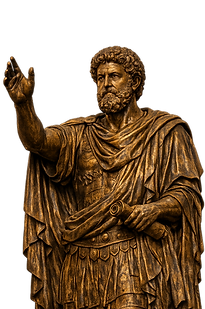
Seneca, Marcus Aurelius, and others emphasized self-discipline, rational decision-making, and accepting what cannot be controlled. For finance, this meant cultivating resilience, avoiding emotional reactions to market swings, and committing to long-term saving and investment.
Marcus Aurelius Antoninus, Roman emperor from 161 to 180 and a Stoic philosopher. He was a member of the Nerva–Antonine dynasty, the last of the rulers later known as the Five Good Emperors and the last emperor of the Pax Romana, an age of relative peace, calm, and stability for the Roman Empire lasting from 27 BC to 180 AD. He served as Roman consul in 140, 145, and 161.